
Key takeaways
- Six of eleven World Brewing Championship winners between 2011 and 2021 used a V60, making it the most competition-proven manual pour-over device available.
- The V60's cone shape and spiral ridges encourage even extraction, producing a clean, bright cup that highlights the coffee's natural flavour characteristics.
- Variables like grind size, water temperature, and pouring technique are all adjustable – but mastering one at a time is what separates a good cup from a great one.
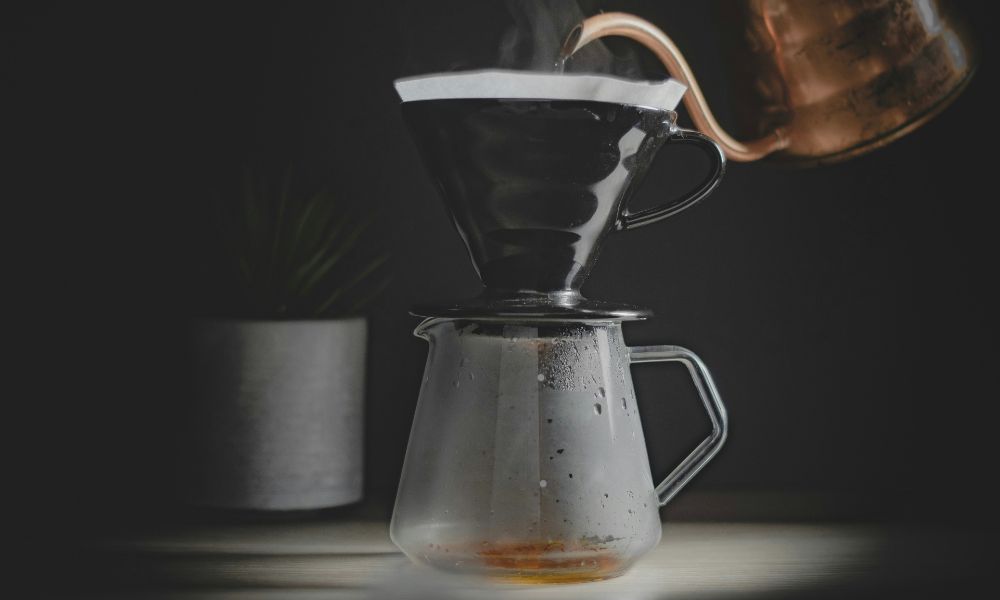
The V60 has earned its place over more than two decades as the gold standard of manual pour-over. Its V-shaped cone, angled at 60 degrees, and its spiral ribs are more than iconic – they're functional, giving you precise control over water flow and extraction.
That control is why the V60 dominates at competition level. Six of the eleven World Brewing Championship (WBrC) winners between 2011 and 2021 chose it. One of them is Stefanos Domatiotis, who took the title in 2014. He is now a World Coffee Events judge, a coach to other champions, and the founder of Create, where he trains baristas and roasts his own coffee. He shared his award-winning V60 coffee brewing recipe with us.

V60 coffee brewing instructions
Yes – V60 coffee brewing is precise by design, but approachable for anyone willing to learn the fundamentals.
Like other manual methods, it doesn't come with a rigid rulebook. There are a few core guidelines, but the beauty lies in fine-tuning the variables. "My V60 brewing process is designed to highlight the delicate flavours of the coffee," Stefanos explains.
Before anything else, gather the following:
- V60 dripper
- Paper filters
- Filtered water
- Kettle, preferably with a long, narrow spout
- Water thermometer, if your kettle doesn't display the temperature
- Digital coffee scale
- Timer
- A server or mug
- Fresh ground coffee (or a grinder, if using whole beans)
"For my winning recipe from 2014, I typically use a coffee-to-water ratio of 1:16," Stefanos shares. "For 15 grams of coffee, I use 250ml of water." His water temperature sits at 93°C.
Here is his award-winning V60 coffee brewing recipe, step by step:
Step 1 – Preparation: Rinse the paper filter in the dripper and discard the water. Add coffee and gently shake to flatten the bed.
Step 2 – Bloom (0:00–0:35): Pour 40ml of water over 10–12 seconds, ensuring all grounds are saturated. Let it rest for 35 seconds.
Step 3 – First pour (0:35–1:00): Add water to a total of 120ml, pouring in a steady spiral.
Step 4 – Second pour (1:15): Once the water drops slightly, add water until the total is 180ml.
Step 5 – Final pour (1:30): Pour to a final weight of 250ml.
Step 6 – Finish: Allow the cup to drain completely. Total time should be around 2:00 to 2:10 maximum.
Step 7 – Serve: Swirl the final coffee before serving for better aroma and consistency.
Our V60 coffee brewing tips
Pouring is at the heart of every V60 guide, and for good reason. Almost everything that shapes the quality of your cup – from extraction time to water flow control – ties back to how you pour.
"I am very much in favour of quick pouring, so that the outcome is a clearer coffee, more transparent, without bitterness," Stefanos explains of his 2:00–2:10 method.
The WBrC has produced some of the most exciting pouring techniques around. Alongside Stefanos' winning formula, there is James Hoffmann's method, Hario ambassador Scott Rao's method, Tetsu Kasuya's 4:6 method, and Matt Winton's five-pour recipe.
All of them let you manipulate body, acidity, and sweetness through custom circular pours, pulse intervals, and bloom times. A gooseneck kettle gives you far greater pouring control, making even extraction much easier.
The foundation of it all, however, is grind size. It determines how fast water flows through the coffee bed and how efficiently the flavour is extracted.
"I also encourage adjusting grind size and experimenting with your grinder based on the coffee's roast profile," Stefanos adds. As a general rule, he says, "Finer grinding means more aromas!" – which is why this approach suits the V60's shorter coffee-making time.
For other variables – ratios, water temperature, and agitation – standard benchmarks are a useful reference point. The National Coffee Association pour-over guide is one such resource. That said, these variables are yours to customise depending on the recipe and how creative you want to get.
Stefanos' advice is to master one technique at a time. "Consistency in the brewing technique is crucial for replicating great flavours," he explains. "No need for circular movements that you can't really repeat in your second cup."

Is V60 coffee brewing the best method?
Yes – for those who value clarity, precision, and control, V60 coffee brewing stands out as the gold standard of manual pour-over.
Despite slight variations to its core design elements, the V60 has never lost that status. "The V60 pour-over method is unique due to its design and making a coffee technique, which allows for precise control over water flow and extraction," Stefanos explains.
Its iconic shape adapts effortlessly to different pouring techniques without sacrificing cup quality. "The cone shape, combined with the spiral ridges on the inside, encourages even extraction and enhances the coffee's clarity and brightness," Stefanos points out. "Overall, this results in a clean cup that showcases the coffee's inherent flavours."
That was always the goal. Back in the 1980s, immersion devices dominated the market. Hario's designers set out to explore whether a cone-shaped device could produce something cleaner by letting water pass through the grounds rather than steeping them. By 2004, they had refined the design and the Hario V60 was born – one that has since transformed the manual pour-over experience.
Even though it requires a steady hand and mastery of pouring, Stefanos is convinced the learning curve is worth it. "The V60 is perfect for anyone looking to elevate their coffee experience," he reassures, "whether they are beginners eager to learn or seasoned makers looking for precision in their craft."
It also makes you a better coffee thinker. "It makes you appreciate the art of making a coffee, experiment with the variables, and usually highlights the unique characteristics of different beans," he adds.
With Zesto's coffee selection, the best is yet to come. It's your chance to explore thoughtfully sourced beans that lift your mood, fuel your mornings, and set you up for a great day. Find the next best thing after this V60 coffee guide by browsing our collections here.
FAQs
What is the best coffee-to-water ratio for V60 coffee brewing?
A 1:16 ratio is the recommended starting point – 15g of coffee to 250ml of water. From there, adjust based on the roast profile and your preferred flavour outcome.
What water temperature should you use for V60 coffee?
93°C is the recommended water temperature. This suits most roast profiles, but experimenting slightly higher or lower, depending on the coffee, is encouraged.
How long should V60 coffee brewing take?
Total time from first pour to finish should be around 2:00 to 2:10 minutes. A shorter, quicker pour produces a cleaner, clearer cup with less bitterness.
