
Key takeaways
- The Chemex's thick, bonded paper filter traps oils and micro-grounds, producing a clean, light, smooth cup with low bitterness.
- Roast profile sets the ratio, and grind size controls the flow, so both need care to avoid a stalled or under-extracted cup.
- Beyond taste, the Chemex offers a slow, meditative ritual and an iconic glass-and-wood design admired since its 1941 debut.
The Chemex has earned its place in pour-over coffee through the flavours and aromas it produces. It dates back to 1941, when Peter Schlumbohm, a German chemist, applied his scientific background to design it.
Schlumbohm also created the distinctive paper filter used alongside it. The third wave speciality coffee movement popularised it further, along with other pour-over devices. Beyond competitions and speciality shops, it works just as well at home.
Brodie Vissers is one of those eager to learn and perfect how to brew coffee with a Chemex. His experience comes from years at Journee Studios as a filmmaker, marketer and storyteller for drink brands around the world. Read on for his instructions.

How to brew coffee with a Chemex: our instructions
Knowing how to brew coffee with a Chemex begins with a simple pour-over process and a few key tools.
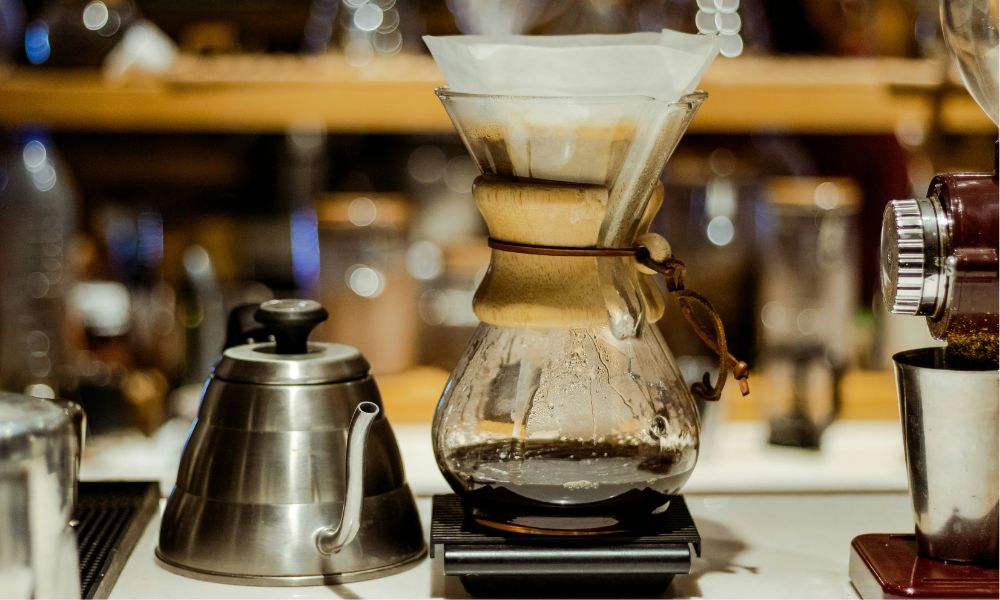
Like every pour-over device, the Chemex works by pouring water through a bed of coffee and a thick, bonded paper filter. Sizes range from three-cup to ten-cup models. The choice is yours.
You will also need:
- Spouted or gooseneck kettle
- 1 litre of filtered water
- Digital scale (with timer)
- Whole bean coffee (or medium-coarse if using ground)
- Burr grinder
- Cups or mugs for serving
For the ratio, Brodie lets the roast profile lead. "I'll use 1:15 for a more conventional roast, and 1:16 if it's a slightly denser or lighter coffee," he explains. His recipe for how to brew coffee with a Chemex then unfolds as follows:
Step 1: "Put your water on to boil," he starts. "Set your kettle to around 95ºC if you can." Get it going so it is ready when you are.
Step 2: "With the full-size Chemex, I'll start setting up the brew by wetting the paper filter with a bit of warm tap water," he explains. Full-size models are typically eight-cup or ten-cup.
Step 3: If grinding your own beans, Brodie goes a little coarser. "Place everything on the scale, and weigh out 30g of ground coffee," he adds. Load the coffee into the filter afterwards.
Step 4: "When the water is hot, and the scale is tared, I start by pouring in a spiral motion up to around 90ml of water," Brodie goes on. "The key is to make sure all the coffee is wet evenly, and there are no dry clumps."
Step 5: After about 30 seconds, Brodie moves to the second pour. "I often try to fill up the Chemex as much as possible to help let gravity do its work," he points out. "This might be closer to 250ml."
Step 6: As it drips, he lifts the Chemex for a quick swirl to gather grounds on the filter walls and level the bed. "Continue pouring to our desired 450ml to 480ml of water," he adds.
Because Chemex filters are 20–30% thicker than standard filters, the water drains much more slowly. "I cross my fingers that it finishes by around 3 minutes," Brodie admits, "but it's usually 4 or more." When the Chemex coffee is ready, pour it into your cup or mug and enjoy.
How to brew coffee with a Chemex: expert tips
The main challenge in how to brew coffee with a Chemex is its smooth glass funnel, which needs a few adjustments to manage.
The iconic hourglass shape defines the Chemex. The upper cone works as the funnel and connects seamlessly to the lower decanter. "One of the drawbacks of brewing with the Chemex is the funnel itself is perfectly smooth glass," Brodie points out.
Unlike the Hario V60, there are no ridges or knobs to release hot air from the bottom. "Just one long pouring spout that usually hugs the dipping paper filter as the water gets heavier," he adds.
This reverse vacuum pressure causes airlocks and an inconsistent flow rate. "Your coffee drip slows immensely (hence the leaning towards coarser ground)," Brodie explains.
"I usually find myself just lifting up the entire filter with my hands to release the pressure and let it drip while pinching it with my fingers," he continues. "I'll set it back down after a few seconds and let it ride out."
Pulse pouring, as Brodie did with three pours split by a few seconds, often helps. It stops the grounds from clogging the filter and pulls more dissolved solids into the cup.
Remember to use a gooseneck kettle, since it gives better, more precise flow control. Pour the water in a tight spiral from the centre outward. Avoid the filter walls, or the water slides down the glass without touching the ground, giving a weak, uneven cup.
Grind size matters just as much. Too fine can stall the process entirely, while too coarse pours through fast and under-extracts. If either happens, adjust the size until you hit Brodie's target times and the flavour you want.
As with any pour-over, these variables are not fixed. As you master how to brew coffee with a Chemex, experiment with each until you find your ideal cup.

Is Chemex the best way to make coffee?
The Chemex is the best choice for anyone who wants a clean, light, tea-like cup, though richer methods suit fuller-bodied tastes.
One of the Chemex's charms lies in its proprietary, heavy-duty paper filters. Because they are thicker than standard filters, these filters trap almost all coffee oils and micro-grounds.
The result is a remarkably smooth, light and clean cup with low bitterness. It suits the delicate, fruity and floral notes found in premium light-roast single-origin coffees.
For Brodie, his affection for Chemex coffee traces back to his first cup of speciality coffee. "I still love the Chemex, and one reason is just nostalgia," he explains. "It was the first brewer I drank speciality coffee from, and it always brings me back."
The iconic design strengthens that connection. "Another reason is the timeless glass aesthetic," he adds, and he is not alone. In 1959, the Illinois Institute of Technology recognised the Chemex among the 100 best-designed products of modern times.
"In a world where a new brewer is released every week, with the latest tech specs and engineered materials, there's something special about holding glass and wood," Brodie continues.
The process also slows you down to enjoy the moment. Brodie describes the meditative side of Chemex coffee, "by watching the steam rise out of the bulb, and pouring into your glass with the elegance of a waterfall of liquid gold."
Some people prefer something light, clean, smooth and almost tea-like, and that draws them to the Chemex. Others want a fuller-bodied, richer, more complex cup. For that, devices like the Hario V60, French press or AeroPress tend to be the go-to options.
There are plenty of cup-size models too, which makes the Chemex versatile for any occasion. "The size is great for sharing, or those big cups we all crave once in a while," Brodie points out.
Learning how to brew coffee with a Chemex is just the beginning. Explore Zesto's collection of thoughtfully selected coffees, full of vibrant flavours and aromas, and make your way to your happy place.
FAQs
Is learning how to brew coffee with a Chemex difficult?
No. The process is a simple pour-over, though the slow-draining filter takes practice. Adjust your grind and pour in pulses to hit a clean, balanced cup.
What grind size should you use for a Chemex?
A medium-coarse grind works best. Too fine can stall the flow entirely, while too coarse pours through quickly and under-extracts, so adjust to hit the target time.
What is the best coffee-to-water ratio for Chemex coffee?
Brodie recommends letting the roast lead. He uses 1:15 for a more conventional roast, and 1:16 for a slightly denser or lighter coffee.
